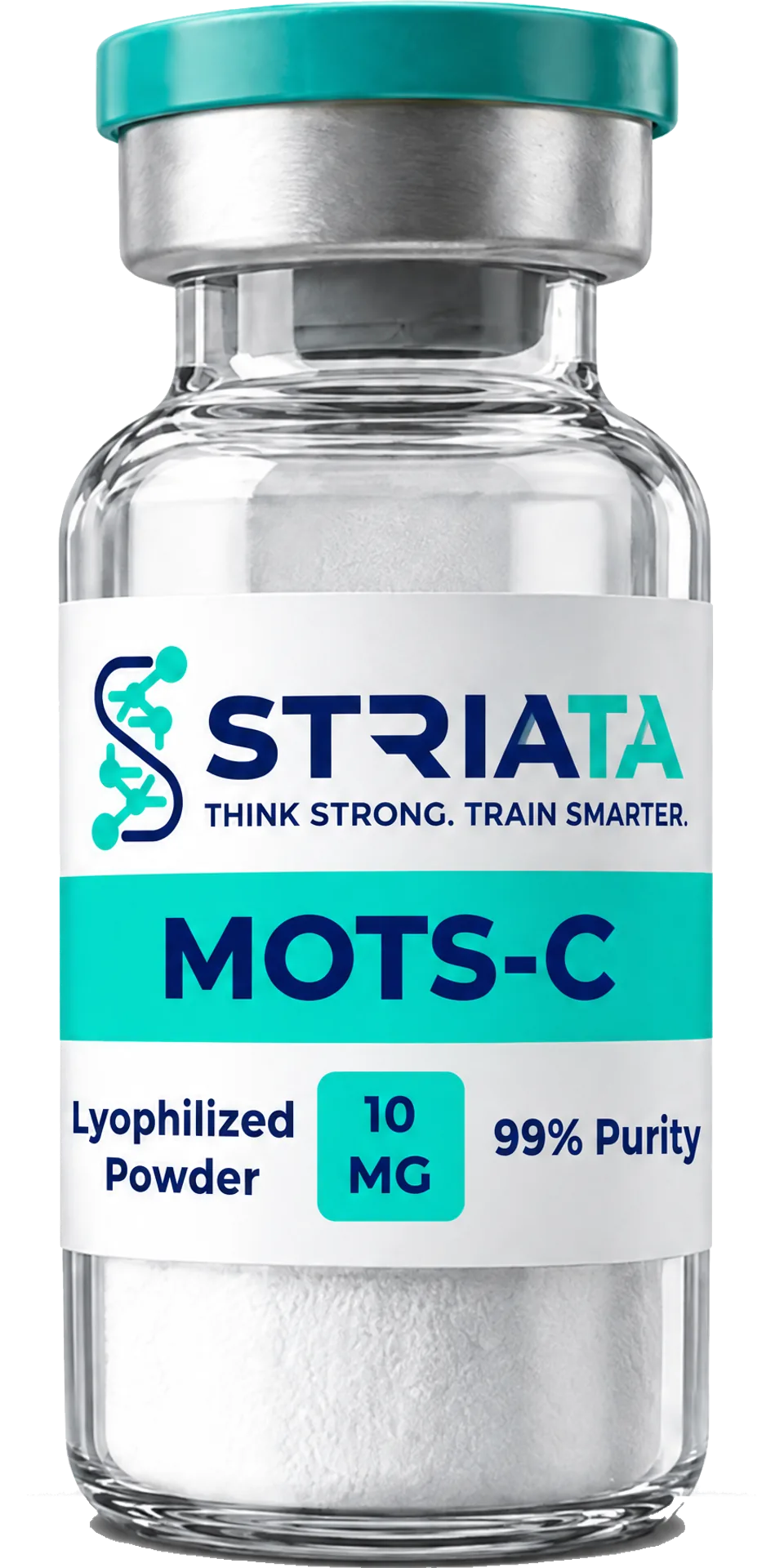
MOTS-C
A peptide encoded not in the cell nucleus but in the mitochondria — the closest thing in the catalogue to an exercise signal.
A mitochondrial-derived peptide studied in mice for insulin sensitivity, metabolic function and physical capacity.
- Also known as
- Mitochondrial open reading frame of the 12S rRNA type-c
- Class
- Mitochondrial-derived peptide
- Evidence
- Animal and cell studies
- FDA
- Not approved
- WADA 2026
- Prohibited at all times under S4.4 (named)
Concentrations · 1 vial
from R 40010mg selected — in stock and shipping now.
About MOTS-C
MOTS-c is unusual in where it comes from. Most peptides are encoded in nuclear DNA; MOTS-c is encoded in the mitochondrial genome, which puts it in a small class of mitochondrial-derived peptides discovered only in the last fifteen years. It appears to act as a signal from the mitochondria to the rest of the cell about energy status.
That is why its research reads more like exercise physiology than endocrinology: metabolic flexibility, glucose handling, and exercise capacity. Levels rise with exercise and fall with age, and the research interest is in what supplying it does for people in whom both of those are working against them. It sits in the hormonal category here because it acts as a signalling molecule, but most people buy it for metabolism and energy.
Specifications
Evidence level: Animal and cell studies · Human data are limited to measuring natural blood levels.
- Sequence
- MRWQEMGYIFYPRKLR (16 amino acids), encoded in mitochondrial DNA
- Formula
- C101H152N28O22S2 PubChem ↗
- Molecular weight
- 2174.6 g/mol
- CAS number
- 1627580-64-6
What it’s researched for
Research context, not medical advice. Everything we sell is supplied for research purposes.
Metabolic function
The core interest: glucose handling and metabolic flexibility, studied as a signal the mitochondria send when energy is short.
Exercise capacity
MOTS-c rises with exercise, which is why it is often described as an exercise mimetic alongside SLU-PP-332 — a different mechanism aimed at similar ground.
Cellular energy
Studied for mitochondrial function directly rather than through a hormonal intermediary, which is what distinguishes it from the GH secretagogues.
What the research does not show
The limits of the evidence, stated as plainly as the findings.
- Controlled human trials of supplied MOTS-c.
Reconstitution and storage
The 10mg vial with 2 mL of bacteriostatic water gives 5mg/mL. The 20mg vial is the better value per milligram of the two in-stock sizes. Unopened vials are stable at room temperature in transit but belong in a fridge once they arrive, and out of a parked car in a Highveld summer.
Questions we get about MOTS-C
Sources
- Lee C, Zeng J, et al. The mitochondrial-derived peptide MOTS-c promotes metabolic homeostasis and reduces obesity and insulin resistance. Cell Metabolism, 2015.
- Reynolds JC, Lai RW, et al. MOTS-c is an exercise-induced mitochondrial-encoded regulator of age-dependent physical decline and muscle homeostasis. Nature Communications, 2021.
- World Anti-Doping Agency. International Standard Prohibited List 2026. WADA, 2025.
Often bought with it
Order MOTS-C in South Africa
Everything ships from Johannesburg, nationwide. Add it to your order slip, send the slip on WhatsApp, and we’ll confirm stock, pricing and delivery before you pay a cent.