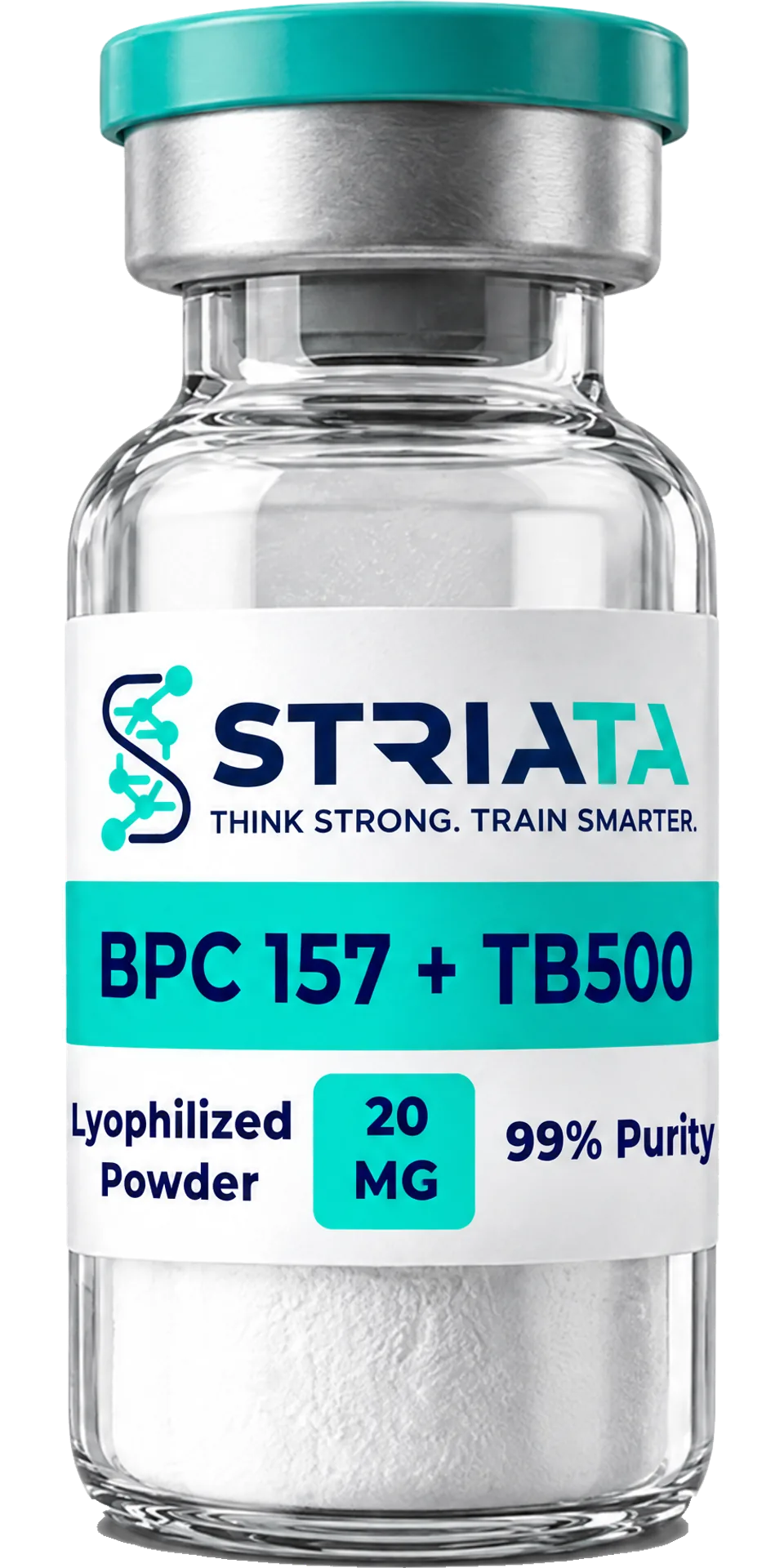
BPC-157 + TB-500 Wolverine Stack
The two best-known repair peptides in one vial, in equal amounts.
BPC-157 and TB-500 in one vial: the two best-known tissue-repair research peptides, each studied separately for tendon, muscle and wound healing.
- Also known as
- BPC-157 (body protection compound 157) with TB-500 (a thymosin beta-4 peptide)
- Class
- Blend of two tissue-repair research peptides
- Evidence
- Animal and cell studies
- FDA
- Neither is approved
- WADA 2026
- Prohibited at all times: BPC-157 under S0 and TB-500 under S2 (both named)
Concentrations · 1 vial
from R 65010mg+10mg selected — in stock and shipping now.
About BPC+TB Wolverine Stack
BPC-157 and TB-500 are the pair most people arrive at after reading about peptide recovery, and they are usually bought together because they work on different parts of the same problem. BPC-157 is a synthetic fragment of a protein found in gastric juice, and research interest centres on localised repair — blood vessel formation at an injury site, tendon and ligament fibroblasts, and the gut lining. TB-500 is a synthetic form of Thymosin Beta-4, and its interest is systemic: cell migration, actin regulation and getting repair cells to where the damage is.
Running them together is what the "Wolverine" name refers to. The stack vial saves you reconstituting two products on the same schedule and keeps the ratio fixed, which is why it is the format most people move to once they have used both separately. It is also the base of The Wolverine Protocol on the stacks page, where it is paired with GHK-Cu and KPV for longer or more stubborn recovery work.
Specifications
Evidence level: Animal and cell studies · Each compound has been studied separately, almost entirely in animals; the blend itself has not been studied.
- Composition
- BPC-157 and TB-500 in equal amounts (5mg + 5mg, 10mg + 10mg or 15mg + 15mg)
- BPC-157
- 15 amino acids, GEPPPGKPADDAGLV · C62H98N16O22 · MW 1419.5 · CAS 137525-51-0 PubChem ↗
- TB-500
- Thymosin beta-4 peptide. The name covers both the full 43-residue protein and a 7-residue fragment (Ac-LKKTETQ).
Certificate of analysis
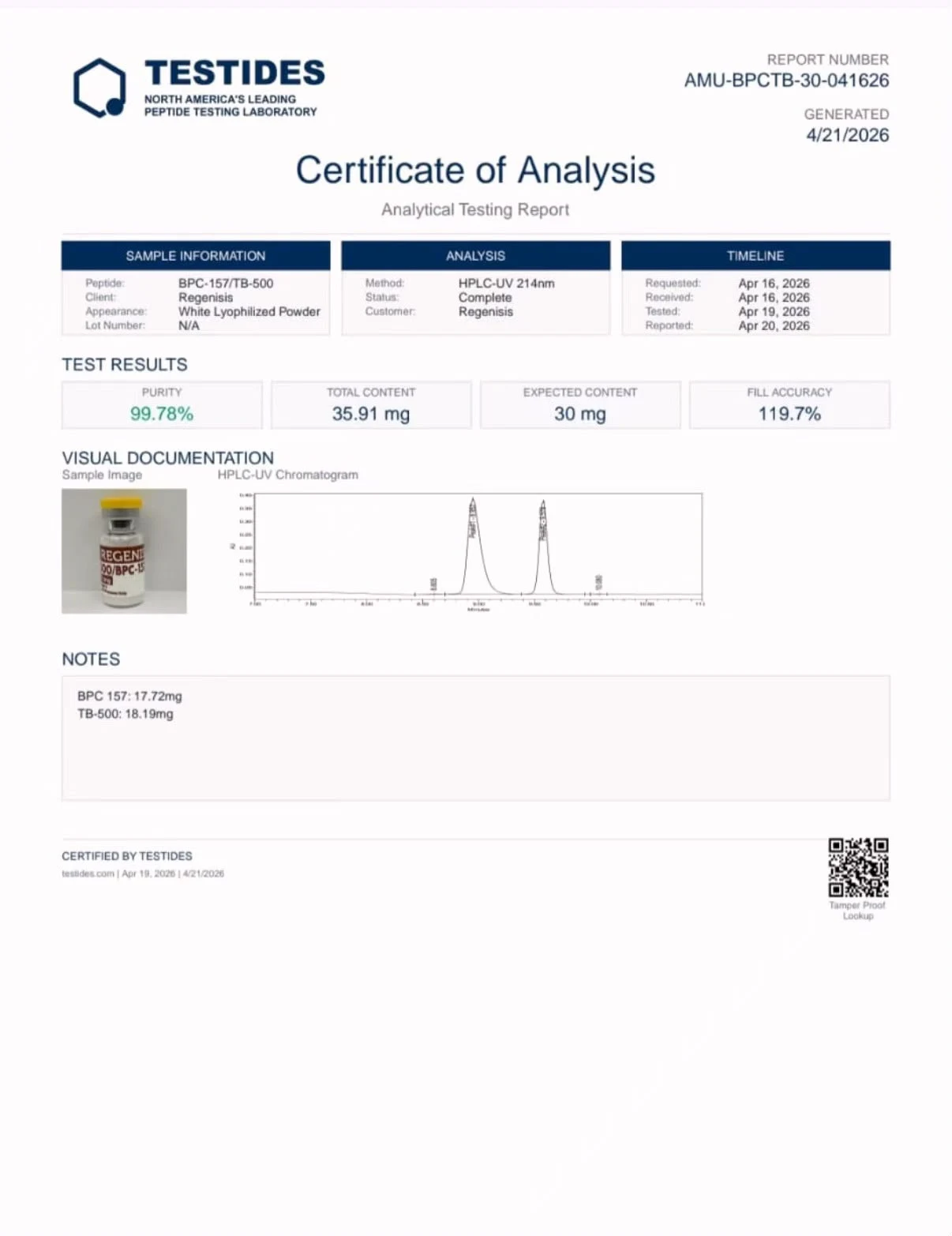
Independent lab test · Testides, 20 April 2026
- Report
- AMU-BPCTB-30-041626
- Sample tested
- BPC-157/TB-500 blend, 30 mg expected
- Client on report
- Regenisis
- Method
- HPLC-UV, 214 nm
- Purity
- 99.78%
- Total content
- 35.91 mg (119.7% of label)
- BPC-157
- 17.72 mg
- TB-500
- 18.19 mg
Results apply to the sample the lab tested. Scan the tamper-proof QR code on the certificate to look it up on testides.com.
How our batches are tested
Demand for peptides has grown quickly, and the factories that make them now run batches far more often than they used to. When batches were large and infrequent, we could test each one ourselves. At today’s pace that stopped being practical: independent testing is priced per sample, per compound, in US dollars.
So we share it. STRIATA is one of a group of companies across South Africa that buy from the same factory, and together we split the cost of independent lab testing. Each test is paid for once and shared by everyone who buys from that factory, which lets the testing keep pace with the batches.
That is why the client named on a certificate may be another company, and why the vial in a lab’s photo may carry another brand’s label: the report names whoever sent that sample in. We publish every certificate exactly as the lab issued it, unedited. If you have a question about a certificate, ask us on WhatsApp.
What one test costs at Janoshik Analytical
- BPC-157 or TB-500US$215
- GHK-Cu, Semax, Selank or EpithalonUS$290
- Two-peptide blend (BPC-157/TB-500, CJC/Ipamorelin)US$320
- GLP-1 test (semaglutide, tirzepatide, retatrutide)US$360
- NAD+US$450
- KLOW four-peptide blendUS$800
- Endotoxin screen, added to any test+US$180
Per sample, from Janoshik’s published price list, checked 17 October 2026.
What it’s researched for
Research context, not medical advice. Everything we sell is supplied for research purposes.
Soft tissue and tendon
The combination most often researched for tendon, ligament and muscle injury — the slow-healing connective tissue that responds poorly to rest alone.
Training load
Used by athletes through heavy blocks rather than only after injury, on the reasoning that recovery capacity, not effort, is usually what caps training volume.
Gut lining
BPC-157 in particular is studied for the gut, which is why the stack often appears in protocols aimed at inflammation rather than a specific injury.
Post-surgical recovery
A common research context for both compounds, and the reason the 15mg+15mg tier exists — longer protocols need more material.
What the research does not show
The limits of the evidence, stated as plainly as the findings.
- Any study of BPC-157 and TB-500 given together. The case for the blend rests on their mechanisms looking complementary.
- Controlled human trials of BPC-157. The human evidence is one small uncontrolled case series, and a 2025 review weighed the regeneration data against unknown risks.
- Human trials of the TB-500 fragment. The eye-healing trials used full thymosin beta-4, a larger molecule.
Reconstitution and storage
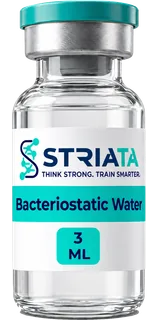
The 10mg+10mg vial holds 20mg of peptide in total. Reconstituted with 2 mL of bacteriostatic water, it holds 10mg of combined peptide in each mL. Add the water down the side of the glass rather than straight onto the powder, and swirl rather than shake. Unopened vials are stable at room temperature in transit but belong in a fridge once they arrive, and out of a parked car in a Highveld summer. Once reconstituted, refrigerate and use within about four weeks.
Questions we get about BPC+TB Wolverine Stack
Sources
- Staresinic M, Sebecic B, et al. Gastric pentadecapeptide BPC 157 accelerates healing of transected rat Achilles tendon and in vitro stimulates tendocytes growth. Journal of Orthopaedic Research, 2003.
- Chang CH, Tsai WC, et al. The promoting effect of pentadecapeptide BPC 157 on tendon healing involves tendon outgrowth, cell survival, and cell migration. Journal of Applied Physiology, 2011.
- Lee E, Padgett B. Intra-Articular Injection of BPC 157 for Multiple Types of Knee Pain. Alternative Therapies in Health and Medicine, 2021.
- McGuire FP, Martinez R, et al. Regeneration or Risk? A Narrative Review of BPC-157 for Musculoskeletal Healing. Current Reviews in Musculoskeletal Medicine, 2025.
- Goldstein AL, Hannappel E, et al. Thymosin beta4: actin-sequestering protein moonlights to repair injured tissues. Trends in Molecular Medicine, 2005.
- Sosne G, Ousler GW. Thymosin beta 4 ophthalmic solution for dry eye: a randomized, placebo-controlled, Phase II clinical trial conducted using the controlled adverse environment (CAE™) model. Clinical Ophthalmology, 2015.
- World Anti-Doping Agency. International Standard Prohibited List 2026. WADA, 2025.
Often bought with it
Order BPC+TB Wolverine Stack in South Africa
Everything ships from Johannesburg, nationwide. Add it to your order slip, send the slip on WhatsApp, and we’ll confirm stock, pricing and delivery before you pay a cent.