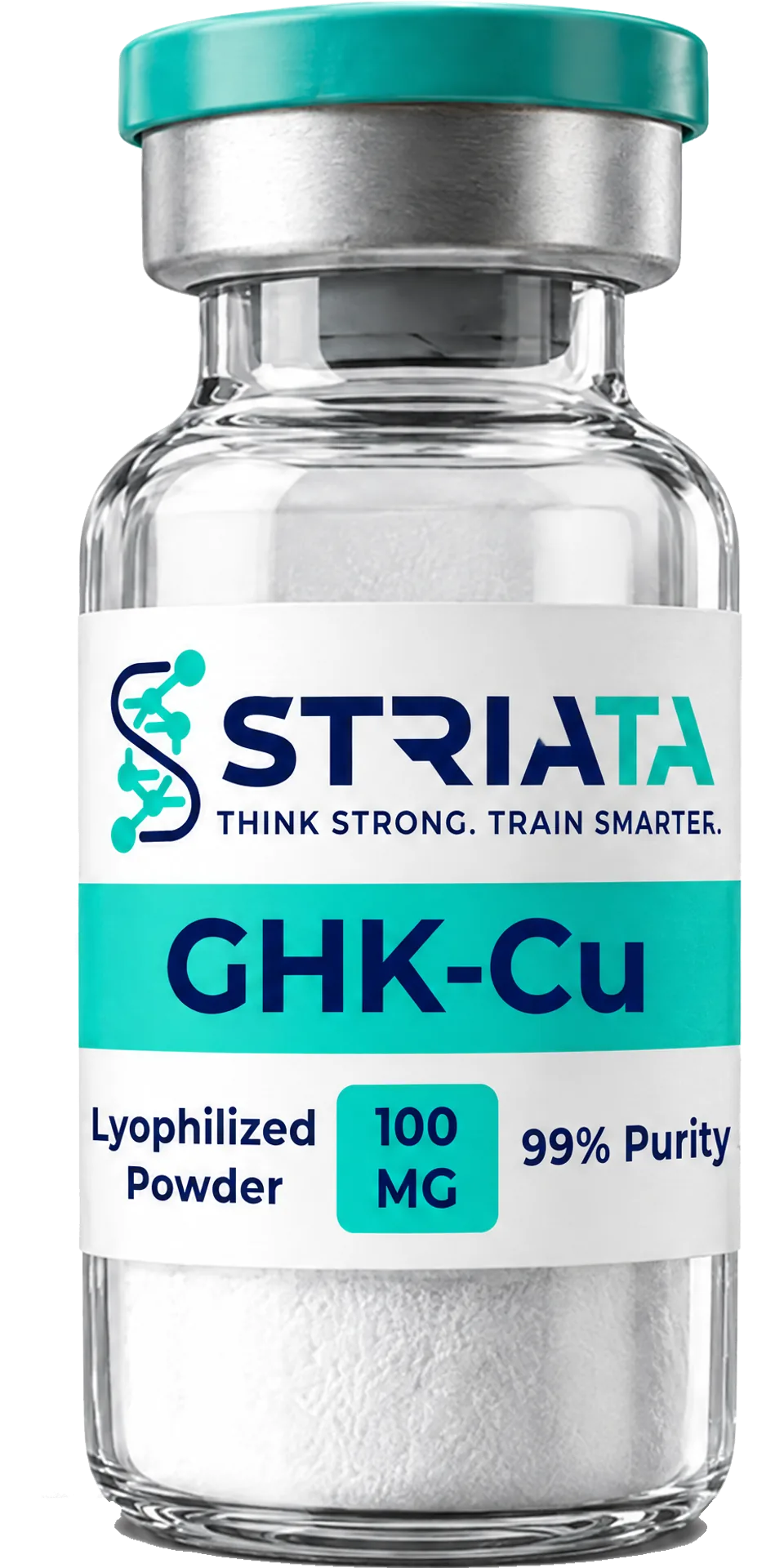
GHK-Cu
The copper peptide the entire category is named after, in a 100mg vial — the most researched skin compound we stock.
The copper tripeptide studied for collagen production, wound repair and skin remodelling, mostly in laboratory and animal research.
- Also known as
- Copper tripeptide-1; prezatide copper
- Class
- Naturally occurring copper-binding tripeptide
- Evidence
- Animal and cell studies
- FDA
- Not approved as a drug
- WADA 2026
- Not named
Concentrations · 1 vial
R 450100mg selected — in stock and shipping now.
About GHK-Cu
GHK-Cu is a naturally occurring copper tripeptide found in human plasma, and its concentration falls sharply with age — roughly a two-thirds decline between your twenties and your sixties. That decline is what made it interesting to researchers in the first place, and it has since accumulated one of the deepest research literatures of any peptide in cosmetics, covering collagen and elastin synthesis, skin remodelling, hair follicles and wound healing.
It is the compound behind both the GLOW and KLOW stacks and behind our topical serum, and this 100mg vial is the raw material form. At R450 for 100mg it is also the best value per milligram in the skin category by a wide margin, which is why people running longer protocols buy it here rather than as part of a stack.
Specifications
Evidence level: Animal and cell studies · Plus small topical cosmetic studies in people; injected use has little published research.
- Sequence
- Gly-His-Lys (GHK), bound to copper(II)
- Formula
- C14H23CuN6O4 (copper complex) PubChem ↗
- Molecular weight
- 402.9 g/mol
- CAS number
- 89030-95-5
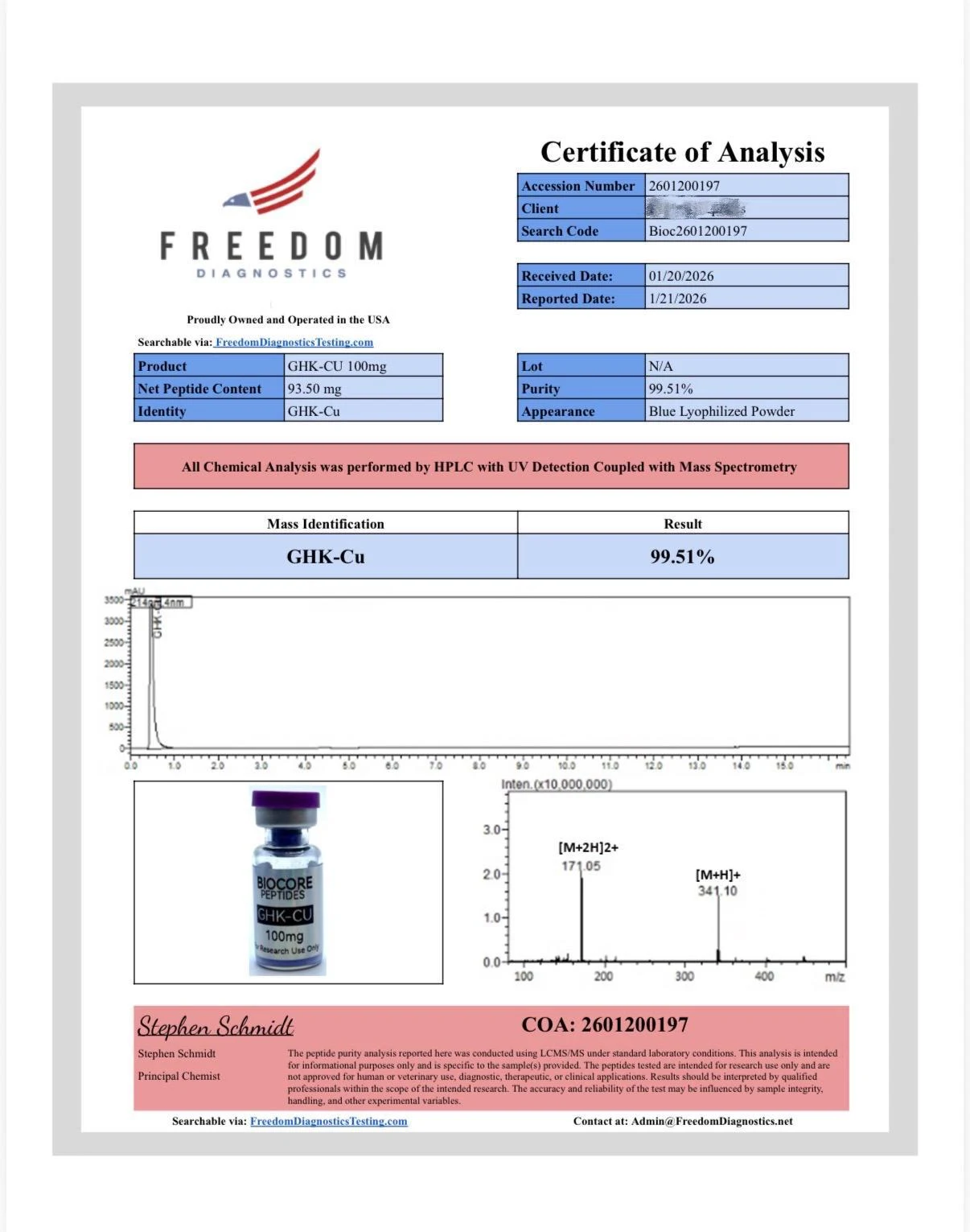
Certificate of analysis
Independent lab test · Freedom Diagnostics, 21 January 2026
- Report
- Accession 2601200197
- Sample tested
- GHK-Cu 100 mg vial
- Client on report
- Blurred on the certificate
- Method
- HPLC with UV detection, coupled with mass spectrometry
- Purity
- 99.51%
- Net peptide content
- 93.50 mg
- Identity
- GHK-Cu, confirmed by mass
Results apply to the sample the lab tested. Search accession number 2601200197 at FreedomDiagnosticsTesting.com.
How our batches are tested
Demand for peptides has grown quickly, and the factories that make them now run batches far more often than they used to. When batches were large and infrequent, we could test each one ourselves. At today’s pace that stopped being practical: independent testing is priced per sample, per compound, in US dollars.
So we share it. STRIATA is one of a group of companies across South Africa that buy from the same factory, and together we split the cost of independent lab testing. Each test is paid for once and shared by everyone who buys from that factory, which lets the testing keep pace with the batches.
That is why the client named on a certificate may be another company, and why the vial in a lab’s photo may carry another brand’s label: the report names whoever sent that sample in. We publish every certificate exactly as the lab issued it, unedited. If you have a question about a certificate, ask us on WhatsApp.
What one test costs at Janoshik Analytical
- BPC-157 or TB-500US$215
- GHK-Cu, Semax, Selank or EpithalonUS$290
- Two-peptide blend (BPC-157/TB-500, CJC/Ipamorelin)US$320
- GLP-1 test (semaglutide, tirzepatide, retatrutide)US$360
- NAD+US$450
- KLOW four-peptide blendUS$800
- Endotoxin screen, added to any test+US$180
Per sample, from Janoshik’s published price list, checked 17 October 2026.
What it’s researched for
Research context, not medical advice. Everything we sell is supplied for research purposes.
Collagen and elastin
The core of the GHK-Cu literature: signalling skin cells to build rather than adding structural protein directly, which is what separates it from a collagen supplement.
Skin remodelling
Studied for texture, fine lines and scarring — the same wound-healing pathways, applied to skin that is not injured.
Hair follicles
A well-documented research interest and a common reason people choose GHK-Cu over other skin compounds.
Antioxidant activity
Researched for antioxidant and anti-inflammatory properties, which is the argument for it in reactive skin that tolerates retinoids and acids poorly.
What the research does not show
The limits of the evidence, stated as plainly as the findings.
- Large controlled trials of injected GHK-Cu.
Reconstitution and storage
A 100mg vial is the largest peptide load in the skin category, so give it room: 2 to 3 mL of bacteriostatic water, added slowly down the glass. At 3 mL that is roughly 33mg/mL. GHK-Cu solution is a distinct blue — that is the copper, and it means the peptide-copper complex is intact rather than that anything has gone wrong. Unopened vials are stable at room temperature in transit but belong in a fridge once they arrive, and out of a parked car in a Highveld summer.
Questions we get about GHK-Cu
Sources
- Pickart L, Thaler MM. Tripeptide in human serum which prolongs survival of normal liver cells and stimulates growth in neoplastic liver. Nature New Biology, 1973.
- Maquart FX, Pickart L, et al. Stimulation of collagen synthesis in fibroblast cultures by the tripeptide-copper complex glycyl-L-histidyl-L-lysine-Cu2+. FEBS Letters, 1988.
- Pickart L, Vasquez-Soltero JM, Margolina A. The human tripeptide GHK-Cu in prevention of oxidative stress and degenerative conditions of aging. Oxidative Medicine and Cellular Longevity, 2012.
- Pickart L, Margolina A. Regenerative and protective actions of the GHK-Cu peptide in the light of the new gene data. International Journal of Molecular Sciences, 2018.
Order GHK-Cu in South Africa
Everything ships from Johannesburg, nationwide. Add it to your order slip, send the slip on WhatsApp, and we’ll confirm stock, pricing and delivery before you pay a cent.